


How to Keep Salon Towels Soft, White, and Hygienic

Pick up a freshly washed salon towel and run it across your forearm. If it feels like sandpaper, you have a problem that's affecting more than just comfort.
Salon towels take a beating unlike anything in a residential laundry. Every shift, they absorb heat protectant, color developer, conditioning treatments, and keratin. They get piled damp in a hamper while you finish a color, run through the wash three times a day, and come out stiff, greyish, and smelling vaguely chemical no matter how much detergent you use.
The frustrating part? Most of the advice online is written for home laundry. It doesn't account for the unique chemistry of a working salon. This guide does.
We'll cover the three things that matter most for salon linen: keeping towels soft, keeping them white, and keeping them compliant with California state board hygiene requirements. And we'll explain exactly where the standard advice goes wrong.
Why Salon Towels Go Stiff and Grey
The stiffness problem is almost always diagnosed as overdrying. But that's only part of the story, and fixing the dryer settings alone won't solve it.
The real culprit is product buildup. Every time a towel absorbs conditioner, keratin treatment, leave-in, or color residue, a thin film of surfactants and proteins coats the cotton fibers. Wash after wash, these layers accumulate. The fibers stop moving freely against each other. The towel feels rigid, absorbs less, and eventually develops that faint chemical smell that no amount of fabric softener covers up.
And here is the part most salon owners don't know: fabric softener makes this dramatically worse.
Common mistake: Fabric softener works by depositing a waxy, lubricating coating on fibers — the same mechanism that makes towels feel temporarily soft. But that coating traps product residue underneath it, reduces absorbency with each wash, and contributes to the grey, dingy appearance that develops over months. For salon towels washed multiple times per day, the effect compounds quickly.
Hard water compounds the problem. North County San Diego water is moderately hard, meaning mineral deposits from calcium and magnesium build up in the fabric alongside the product residue, adding stiffness and preventing detergent from rinsing clean.
The result: towels that come out of the dryer stiff, slightly smelly, and visibly duller than when you bought them — even though you're washing them constantly.
Keeping Them Soft — The Right Wash Routine
The fix is straightforward once you understand the actual cause. Here is the routine that works:
1. Remove fabric softener completely This is non-negotiable. Eliminate it from your routine for four weeks and you'll notice a difference. Your towels will feel less artificially silky at first, then progressively more genuinely soft as the waxy residue washes out.
2. Add white vinegar to the rinse cycle Half a cup of plain white distilled vinegar in the rinse cycle acts as a natural fabric softener and buildup remover. The acetic acid dissolves mineral deposits and product residue, lowers the pH to prevent bacterial growth, and restores fiber loft. It rinses out completely — towels won't smell like vinegar.
3. Use warm water, not hot Hot water sets protein stains — including the keratin, collagen, and hair protein that accumulate from daily use. Warm water (around 104°F) cleans effectively without locking stains in. Save hot cycles for towels that need disinfection after a bloodborne pathogen exposure.
4. Load the washer half full Towels need agitation room to rinse clean. An overloaded drum means detergent and buildup don't fully rinse out — which creates the same problem as fabric softener residue. Half-load towels for best results.
5. Shake before drying, tumble on medium A quick shake before loading the dryer separates fibers and prevents them from drying flat against each other. Tumble dry on medium heat — not high. Over-drying on high is the one place where temperature does contribute to stiffness, by degrading the cotton fibers over time.
Pro tip: For towels that have been through years of fabric softener and product buildup, do a "strip wash" first: wash with hot water, one cup of washing soda (sodium carbonate), and no detergent. Run a second cycle with hot water only. You'll be surprised what comes out.
Keeping Them White — Fighting Stains and Yellowing
White salon towels are the industry standard for a reason: they signal cleanliness visually to clients, and you can see immediately if something isn't fully clean. But keeping them white in a working salon is its own battle.
The golden rule: treat it before the dryer, every time
Heat permanently bonds protein stains, toner, and color to cotton fibers. If a towel goes through the dryer with a stain, accept that stain may be permanent.
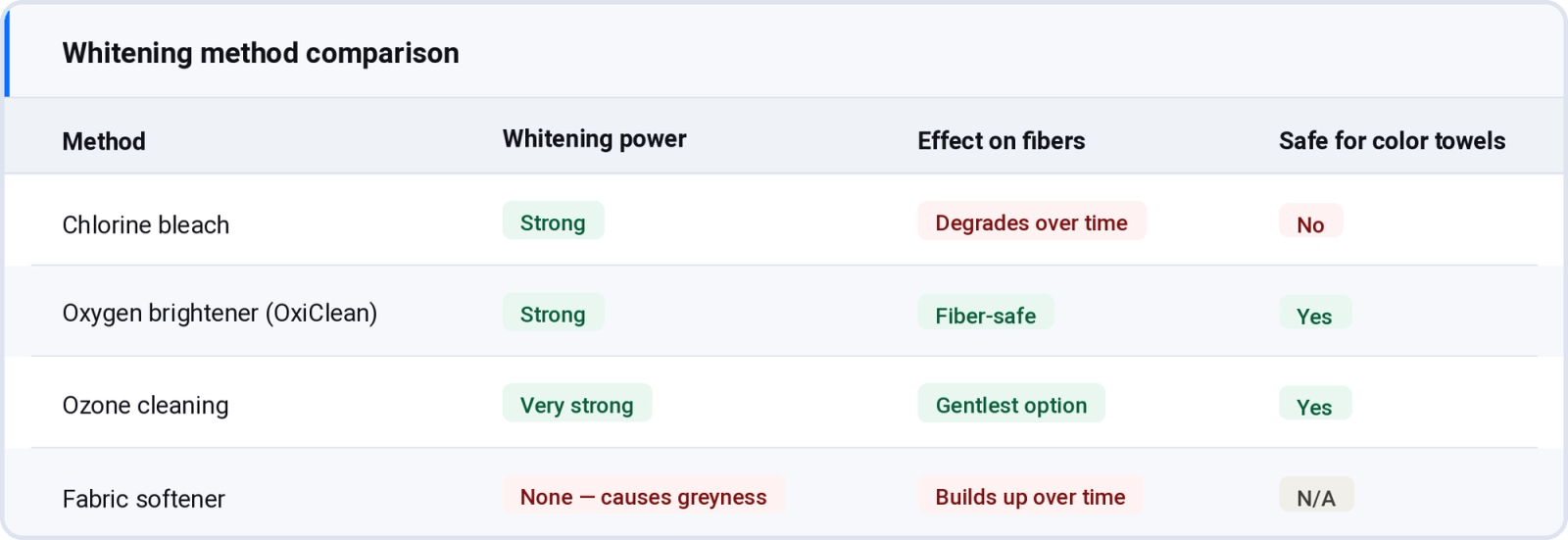
For most salon stains — color residue, toner, and product buildup — an oxygen-based brightener like OxiClean or sodium percarbonate works best. Apply directly to the stain with water, let it sit for 20 minutes, then wash. It's color-safe and won't degrade fibers the way chlorine bleach does over time.
The bleach trade-off
Chlorine bleach is effective at whitening. It's also the primary reason salon towels fall apart after 18 months. Repeated exposure to sodium hypochlorite weakens cotton fibers from the inside, causing thinning, fraying, and yellowing over time — the opposite of what you want.

Best practices for keeping whites white
Always wash white towels separately from colored ones — color migration is permanent. For standard maintenance washing, a small amount of oxygen brightener in every load will gradually keep towels bright without the fiber damage of bleach. Sunlight is also a free and effective whitener: if you air-dry towels, even occasionally in direct sun, UV exposure naturally bleaches cotton.
Staying Hygienic — What California Board Inspectors Look For
Softness and whiteness are about the client experience. Hygiene is about something more serious: your license and your clients' safety.
The California Board of Barbering and Cosmetology is clear on linens. Towels must be freshly laundered and sanitized before each use on a new client. Not daily. Not between appointments when convenient. Before each use.
California Board requirement: Used linens must be stored in a closed, labeled receptacle separate from clean linens. Clean linens must be stored in a clean, closed container until use. Failure to comply is grounds for inspection violations and fines.
The practical math
A busy hair salon doing 12 clients per day needs at least 36 towels in rotation — 12 in use, 12 in the wash, 12 clean and ready. If the wash cycle takes 90 minutes including drying, and you're running loads throughout the day, that's significant time, water, electricity, and labor.
For many salons in Oceanside, Carlsbad, and Vista, the real cost of in-house laundry isn't the detergent — it's the hidden time. Someone has to load the washer between clients, move towels to the dryer, fold, and stock. In a busy salon, that's your stylists doing it, which means client time lost. That's why more local salons are turning to a dedicated salon laundry pickup and delivery service rather than running it in-house.
What an inspector checks
During a routine California Board inspection, an inspector will look for:
- Separated storage — clean and soiled towels in clearly labeled, separate containers, not piled together or in the same cabinet
- Sufficient clean linen stock — enough clean towels on hand to serve the current client load; running low during a busy afternoon is a compliance risk
- Visible cleanliness — towels that are visibly stained, discolored, or odorous are a direct violation, even if they were "washed"; the standard is clean to the eye and nose
The Ozone Advantage — Why Professional Laundry Changes Everything
Here's what the best hotels and medical spas already know: you cannot consistently achieve commercial-grade cleanliness with a residential-scale washer running three times a day.
MAXfresh Laundry uses cold-water ozone cleaning — the same technology used by high-end hotels, hospitals, and resort spas. Here's why it matters for your salon towels specifically:
Kills bacteria and eliminates odor at cold water temperatures Ozone is a natural oxidizer 25 times more powerful than chlorine. It destroys bacteria, fungi, and odor-causing compounds without hot water or bleach — which means no heat damage and no fiber degradation from repeated bleach exposure.
Removes product buildup at the molecular level Ozone oxidizes the conditioner, silicone, and keratin residue that builds up in salon towels, restoring fiber loft and absorbency without the stripping effect of hot water or bleach. Towels come back genuinely soft, not artificially coated.
Whitens naturally without bleach damage The oxidation process brightens cotton fibers the way sunlight does — gradually and without structural damage. Most salon clients report their towels look noticeably brighter within the first four to six weeks of the service.
Extends towel lifespan significantly By replacing hot water, bleach, and fabric softener with cold ozone, the primary causes of accelerated wear are eliminated. Most salons see towel replacement frequency drop by 40–60% within the first year of the service.
Professional pickup and delivery laundry also solves the compliance problem. Every load is processed to state board standards and returned the next day — clean, sorted, and ready to use. Your stylists spend zero time doing laundry.
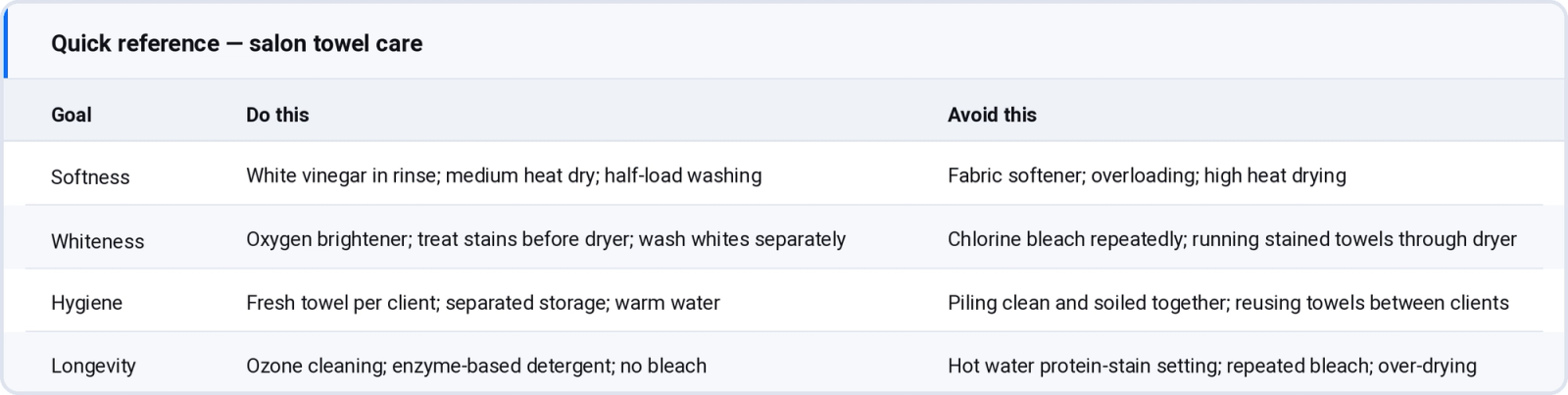
Quick Reference Summary

Frequently Asked Questions
Why do salon towels get stiff after washing? Stiffness is caused by product buildup from conditioners, hair dye, and keratin treatments coating the fibers — compounded by fabric softener, which paradoxically makes towels less absorbent and harder over time by leaving a waxy residue that traps the buildup underneath it. Hard water mineral deposits also contribute. The fix is removing fabric softener, using white vinegar in the rinse cycle, and washing loads at no more than half capacity.
How do hotels keep their towels so soft and white? Hotels use professional commercial laundry services with industrial-grade equipment, controlled water temperatures, and enzyme-based detergents without fabric softener. Many top hotels and spas also use ozone laundry systems, which sanitize and brighten without chlorine bleach — preserving fiber integrity while producing consistently white, soft linens wash after wash.
How often should a salon wash its towels? The California Board of Barbering and Cosmetology requires freshly laundered, sanitized towels for each client — not each day. In practice, a busy salon doing 10–15 clients per day should plan on running two or three full loads throughout the day. This is one reason many Oceanside and Carlsbad salons work with a professional pickup laundry service: it takes the volume out of their hands entirely and guarantees compliance without staff time spent on laundry mid-shift. For a full breakdown of the math, see how often salons should wash their towels.
Is ozone laundry safe for salon towels? Yes. Ozone cleaning sanitizes at cold water temperatures, which is actually gentler on fabric than hot water washing. It eliminates bacteria, viruses, fungi, and odor-causing compounds more effectively than chlorine bleach — without the fiber degradation that repeated bleach exposure causes. It is safe for standard cotton and cotton-blend salon towels.
What is the best detergent for salon towels? Use a fragrance-free, enzyme-based detergent with no built-in fabric softener. Add half a cup of plain white distilled vinegar to the rinse cycle in place of fabric conditioner. For stubborn buildup or whitening, add a scoop of OxiClean or sodium percarbonate directly to the drum before starting the wash cycle.
Most Oceanside and Carlsbad salons that switch to MAXfresh tell us their towel lifespan doubles within 60 days — and their staff stops spending 45 minutes a day on laundry. Schedule your first pickup →