


How to Remove Deodorant Stains from Shirts (Every Fabric)

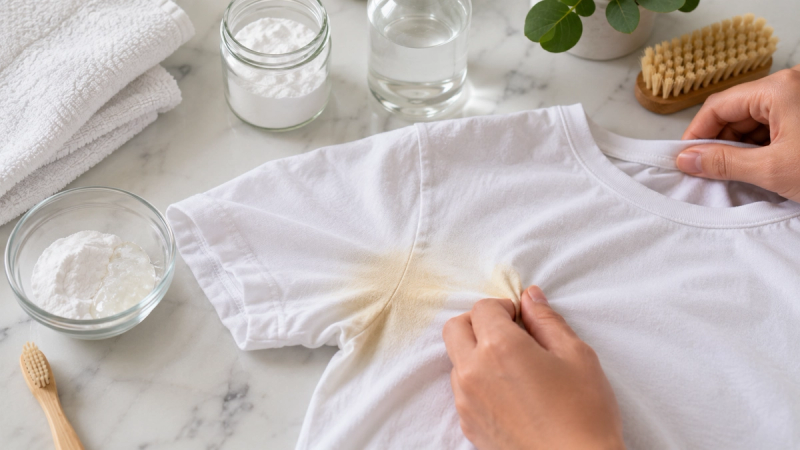
To remove deodorant stains from shirts, match the method to the stain type. Fresh white marks rub off in 30 seconds with fabric-on-fabric friction or a dry microfiber cloth. Set-in yellow buildup needs a paste of baking soda, hydrogen peroxide (3%), and dish soap, scrubbed in, left for an hour, then washed warm and air dried. Never put a treated shirt in the dryer until the stain is fully gone, because heat sets it permanently.
Two Types of Deodorant Stains
Type 1: White marks (fresh). Chalky streaks from putting a shirt on right after applying deodorant. The product sits on the surface and has not bonded yet.
Type 2: Yellow buildup (set-in). Yellow or crusty patches from a reaction between aluminum in antiperspirant and proteins in sweat. The bond strengthens over weeks and will not come out with regular washing.
Deodorant Stains vs. Sweat Stains vs. Detergent Stains
Confirm what you are looking at before treating it. The three look similar but need different fixes.
| Stain type | Appearance | Location | Cause |
|---|---|---|---|
Deodorant | Chalky, white | Underarm area and shirt sides | Product on the fabric surface |
Sweat | Yellow to brownish | Underarm area only | Aluminum and sweat proteins reacting over time |
Detergent | Muted, streaky, sometimes faint blue tint | Anywhere on the garment | Overuse of detergent |
Marks across the chest or hem mean you are overusing detergent, not fighting deodorant.
How to Remove Fresh White Marks (30 Seconds)
- Fabric-on-fabric rub. Grab the stained fabric and rub it briskly against another part of the same shirt.
- Dry microfiber cloth or nylon stocking. Rub firmly. This is the trick wardrobe stylists use on set.
- Damp washcloth, wrung out well. Swipe the streak with a barely damp cloth so you do not leave a water mark.
- Baby wipe. Dab gently and blot. Do not soak or rub.
- Dryer sheet. The anti-static coating lifts residue on dark shirts without risking dye damage.
How to Remove Deodorant Stains While Still Wearing the Shirt
- Rub the fabric against itself where the streak is.
- Use a dedicated deodorant-removal sponge. These small foam sponges lift white marks dry in a few passes.
- Foam hanger cover. The foam cover on some dry-cleaner hangers doubles as a deodorant-mark eraser.
- Damp paper towel, well wrung. Keep it barely damp and swipe fast.
How to Remove Yellow Buildup
The Baking Soda + Hydrogen Peroxide Paste (Best Overall)
- Mix 3 parts baking soda, 2 parts hydrogen peroxide (3%), and 1 part dish soap into a paste.
- Turn the shirt inside out and lay it flat with the stain facing up. Treating from the inside pushes the stain out of the fiber.
- Scrub gently with a toothbrush for 30 to 60 seconds.
- Let it sit 1 hour (or overnight for deep stains).
- Wash warm with regular detergent. Add ½ cup baking soda to the load for extra lift.
- Air dry and inspect. Repeat 2 to 3 times for stubborn stains.
The Vinegar Soak (Best for Waxy Buildup and Odor)
- Soak the stained area in equal parts warm water and white vinegar for 30 minutes.
- Scrub gently with a toothbrush.
- Wash warm.
Vinegar dissolves aluminum salts and the waxy deodorant base, and neutralizes odor-causing bacteria.
Methods That Do Not Use Baking Soda
| Method | How to use it | Best for | Caution |
|---|---|---|---|
Rubbing alcohol | Apply with a cotton pad, let sit 10 to 15 minutes, wash warm | Waxy base on most fabrics | Test on dark fabric first |
Enzyme stain remover (OxiClean, Zout) | Apply to dry fabric, sit 30 minutes, wash warm | Polyester and synthetics | Safe for most colors |
Lemon juice + sun | Saturate stain, lay in direct sun 1 hour, wash | White shirts only | Mild bleaching effect, do not use on color |
How to Remove Deodorant Stains from Dark and Black Shirts
Two rules for dark fabric: never scrub hard (it removes dye along with the deodorant), and never use hydrogen peroxide (it is a mild bleach that will lighten the color).
- Fresh marks: Fabric-on-fabric rub, damp cloth, or dryer sheet.
- Set-in buildup: Dab with 1 tbsp dish soap, 1 tbsp white vinegar, and 1 cup cool water. Blot, do not scrub. Let it sit 15 minutes, rinse cool, wash inside-out, and air dry.
How to Remove Deodorant Stains by Fabric Type
| Fabric | Fresh white marks | Set-in yellow buildup | What to avoid |
|---|---|---|---|
Cotton / cotton blends | Dish soap or fabric rub | Baking soda + peroxide paste, wash warm | Nothing major, cotton is forgiving |
Polyester / synthetics | Fabric-on-fabric rub | Enzyme stain remover on dry fabric, sit 30 min, wash warm | Water-based home mixes bead up and run off |
Silk / wool / delicates | Blot with cool water and a few drops of mild soap | Professional cleaner only | Hydrogen peroxide, baking soda paste, enzyme removers (all damage protein fibers) |
Activewear / performance | Enzyme stain remover, wash warm | Enzyme stain remover, repeat as needed | Fabric softener and hot water |
For full care instructions on silk, wool, and delicates, see our delicates washing guide
Deodorant vs. Antiperspirant
Deodorant kills odor-causing bacteria but does not stop sweat, so it tends to leave fresh white marks rather than yellow buildup. Antiperspirant uses aluminum salts to block sweat, and that aluminum is what reacts with sweat proteins to form the yellow, set-in stains. Switching to an aluminum-free deodorant is the single biggest change you can make to stop new yellow stains.
How to Prevent Deodorant Stains
- Let deodorant dry fully before dressing. About 60 seconds for stick, 30 for roll-on.
- Use only 2 to 3 swipes. Most people apply 2 to 3 times more than they need.
- Apply antiperspirant at night. Skin is dry and there is no shirt to rub off on.
- Switch to aluminum-free deodorant if yellowing is chronic.
- Wash shirts promptly. The longer deodorant sits, the more it bonds.
- Skip fabric softener on underarm-prone shirts. It coats fibers and traps residue.
When to Call a Professional
If you have treated a stain 2 to 3 times and it persists, it has likely permanently bonded with the fiber. For expensive, sentimental, or uniform garments, do not risk home treatment.
MAXfresh Laundry uses commercial-grade enzyme pre-soaks and an ozone-infused wash system that breaks down organic compounds more effectively than standard detergent. We serve Oceanside, Carlsbad, Vista, San Marcos, Encinitas, and North County San Diego. Book a pickup.