


The Surprising Sustainability of Outsourcing Your Laundry

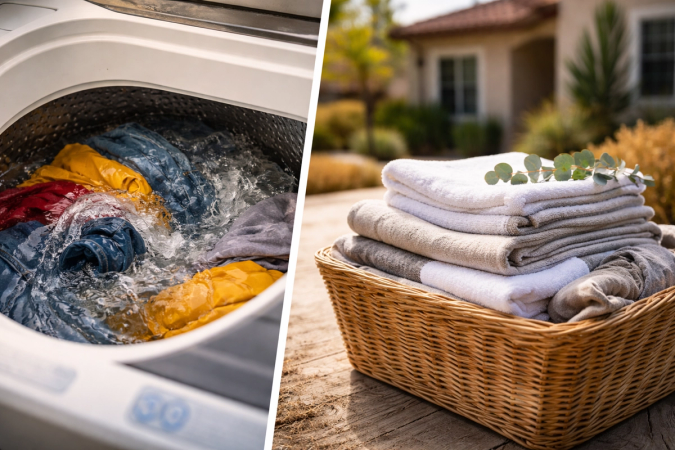
When you think about living more sustainably, laundry probably isn't the first thing that comes to mind. You think about solar panels, reusable bags, maybe driving less. But your washing machine, that clunky thing in the garage that eats your socks and somehow always has a load waiting, is actually one of the bigger water and energy hogs in your home. And if you live in San Diego, where we import about 90% of our water from hundreds of miles away, how you do your laundry matters more than you'd think.
We've been paying a lot of attention to California's water situation lately (it's kind of hard to ignore when your water bill keeps climbing), and we wanted to share why we believe outsourcing your laundry is one of the easiest, most overlooked sustainability wins out there, especially here in North County.
So what's going on with water in California right now?
Quite a bit, actually.
Just three days ago, Governor Newsom launched the California Water Plan 2028, the first time the state has ever set a specific water supply target. The goal is to secure 9 million additional acre-feet by 2040, and officials are calling it a "new era" of water management. That sounds dramatic until you look at what's been happening.
Here's the thing that trips people up: California is technically drought-free for the first time in 25 years. The reservoirs are full, we've had a solid winter of rain, and it feels like we should be in the clear. But we're not.
The California WaterBlog broke it down really well late last month: being drought-free doesn't mean the problem is solved. Groundwater still hasn't recovered from decades of overdraft, the Colorado River (which supplies a huge chunk of our water here in San Diego) is still only at about 33% reservoir capacity, and the La Niña pattern in play this year could easily push us right back to dry conditions in 2027.
And then there's what happened in LA. The devastating wildfires in January 2025 showed us just how fragile our water infrastructure really is. Hydrants ran dry in some neighborhoods, not because there wasn't enough water in the system, but because the infrastructure couldn't handle the simultaneous demand. It was a wake-up call for all of Southern California, and a reminder that conservation isn't just about getting through droughts. It's about keeping our systems resilient for the unexpected.
The bottom line is that conservation isn't optional anymore. California has passed permanent laws requiring 405 urban water suppliers to meet mandatory conservation targets through 2040, regardless of whether we're in a drought or not.
Here in San Diego, it hits different
If you've opened a water bill lately, you already know what we're talking about.
The San Diego City Council approved water rate increases of 14.7% for 2026, with another 14.5% coming in 2027 and cumulative hikes projected to exceed 90% over six years. And it's not just the city of San Diego. Carlsbad's rates jumped 20% in July 2025 with a total 49% increase planned over three years, and Oceanside just approved hikes for 2026 and 2027 as well.
The reason is simple: we import almost everything. The San Diego County Water Authority buys water from the Colorado River and Northern California, and those costs keep rising, with wholesale rates projected to climb 38% to 65% over the next decade.
There is good news on the horizon. Pure Water San Diego is coming online this year, turning recycled wastewater into drinking water and eventually providing nearly half the city's supply. But even with that investment, the rate hikes aren't slowing down because the region's fixed infrastructure costs are enormous.
The takeaway for those of us in North County is pretty clear: every gallon we save matters, both for the environment and for our wallets.
What does laundry have to do with any of this?
More than you'd expect.
The average household does about 300 loads of laundry per year. Even with a newer high-efficiency washer, each load uses around 12 to 15 gallons, which puts you at 3,600 to 4,500 gallons per year at a minimum. If you've got an older top-loader, that number could be double or triple.
And that estimate assumes you're running full loads every time, which most of us aren't. Between the kid who spilled smoothie on their only clean shirt, the towels that sat in the washer too long and need a redo, and the comforter that takes up an entire cycle by itself, the real number is almost always higher than what the math on paper suggests.
There's also the energy side. Heating water accounts for about 90% of a washing machine's energy consumption, so every hot-water load is also a natural gas or electricity load. And when your dryer runs longer than it needs to because your home washer didn't extract enough water during the spin cycle, that compounds the cost further.
Here's where it gets interesting
At MAXfresh Laundry, we use equipment that works fundamentally differently from what's sitting in your garage or laundry closet, and that difference has real sustainability implications.
Our washers spin at 400 G-force. That's industrial-level extraction that no home machine comes close to matching. In practice, it means way more water gets pulled out of your clothes during the wash cycle, and with that water goes more dirt, grime, and detergent residue. Your clothes come out noticeably cleaner. And because they're already so much drier coming out of the washer, they spend far less time in the dryer, which means significantly less natural gas and electricity per load.
We clean with ozone instead of chemicals. Rather than dumping in a full cap of detergent, our MAXfresh Water system uses ozone-infused cold water to sanitize your clothes, killing 99.9% of viruses, bacteria, mildew, and mold. As a result, we use less than half the detergent of a typical wash. That means less chemical runoff going into San Diego's sewers, less residue left on your clothes (which is great if you have sensitive skin), and a cleaner wash achieved through the power of oxidation rather than harsh chemicals.
Every load we run is a full load. When you're doing laundry at home, you're probably running plenty of half-full machines throughout the week. We process hundreds of optimized loads every day with no wasted cycles, no guesswork on detergent amounts, and every machine running at peak efficiency. When you multiply that across all of our customers, the collective water and energy savings compared to everyone doing it individually at home are substantial.
Add it all up and you get less water per load, less than half the detergent, shorter dryer times, lower energy consumption, and cleaner clothes. That's a pretty good deal for something that also happens to give you your weekends back.
You don't have to overhaul your life to make a difference
That's the part we really want to land on. Sustainability doesn't have to mean big, expensive lifestyle changes. Sometimes it's as simple as letting someone with better equipment handle something you were already going to do anyway.
For families in Carlsbad, Oceanside, or Encinitas who are juggling kids, work, and weekend plans, it means getting hours back in your week. For professionals and renters in San Marcos, Vista, or Escondido, it can mean skipping the laundromat entirely with a pickup and delivery service that works around your schedule. And for anyone in Del Mar, Solana Beach, Rancho Santa Fe, or Poway, it's simply one less thing to think about.
In a region where every drop of water is imported, every rate hike is real, and conservation is now the law, outsourcing your laundry is one of the easiest ways to actually do something about it.
MAXfresh Laundry is based in Oceanside and serves all of North County San Diego. We use 400 G-force commercial washers and ozone cleaning technology to deliver a better clean with less water, less detergent, and less energy. We offer free pickup and delivery seven days a week.
Schedule a Free Pickup | View Pricing | Learn About Our Services
Or just call us at (760) 608-5855, Mon through Sun, 9AM to 6PM.